Last updated: 2026-02-17
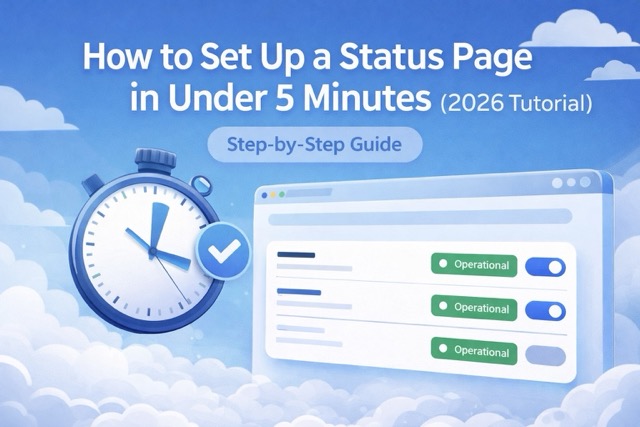
Want to set up a status page with uptime monitoring but think it’ll take hours? I’ll show you the actual workflow - from signup to a live status page checking your site every 60 seconds.
No fluff, no sales pitch. Just the steps.
What you’ll have by the end:
- A public status page showing your service health
- Uptime monitoring checking your site every 60 seconds
- Automatic incident updates when something goes down
- A custom URL (or your own domain if you want)
Time required: 4-5 minutes
Credit card required: No
Technical skills needed: None
[video]
Why this matters
When your site goes down, your users need two things:
- Confirmation it’s not just them - “Is the site down or is it my internet?”
- Updates on what’s happening - “Are they fixing it? Should I come back later?”
A status page solves both problems. Instead of flooding your support inbox with “Is the site down?” tickets, users check your status page and get instant answers.
Step-by-step setup
1) Sign up (30 seconds)
Head to statuspage.me and click Start Free Trial.
Fill in your email and password, or sign in with Google/GitHub. No credit card required - you get a full-featured trial to test everything.
2) Create your status page (60 seconds)
After signup, you’ll see the welcome screen explaining what a status page is. Click Create Your Status Page.
Status Page Name: This is what users see as your page title. Use your company or product name.
Example: “Acme Corp Status”
URL Slug: Your status page will be at https://your-slug.statuspage.me
Example: acme-status becomes https://acme-status.statuspage.me
Click Create Status Page. Done. Your page exists.
3) Add your first monitor (90 seconds)
Now the important part - actually monitoring something.
The form will show “Add Monitor” with a toggle for Create a new Component.
What’s a component? It’s a service or part of your infrastructure. Think “Website”, “API”, “Payment Gateway”, “Mobile App”.
Toggle it on and fill in:
Component Name: Website
Component URL (optional): https://example.com
Monitor Name: Website Monitor
Monitor Type: Site (checks if your website responds)
Check Interval: 60 seconds (how often we ping your site)
Impact on Overall Status: Full impact (if this fails, the whole page shows degraded)
Check Type: Site is up
Site URL: https://example.com (your actual website)
Click Create Monitor.
The system runs an initial check immediately. You’ll see:
Initial check complete
Monitor is Up. Response time: 49ms.
Next prompt: “Include this monitor on the status page?”
Click Yes, include it.
Confirmation: “Monitor included. The monitor is now visible on your status page.”
4) You’re done (seriously)
That’s it. You’ll see the success screen with confetti: “All Done. You’ve successfully set up your status page.”
Your status page is now:
- ✅ Live at your custom URL
- ✅ Monitoring your site every 60 seconds
- ✅ Ready to show incidents if something goes down
Click View my status page to see it in action.
What happens next?
Every 60 seconds, the monitor checks your site. If it gets a successful response, your status page shows “All Systems Operational” in green.
If your site goes down:
- The monitor detects it within 60 seconds
- Your status page automatically updates to show “Partial Outage” or “Major Outage”
- You get notified (email, Slack, Discord - whatever you’ve configured)
- Your users see the incident on the status page instead of hitting your support inbox
Common next steps
Add more monitors: Track your API, database, payment gateway, CDN - anything with a URL or IP.
Set up notifications: Get alerted via Slack, Discord, Telegram, email, or webhooks when monitors fail.
Custom domain: Want status.yourcompany.com instead of the default subdomain? Takes 2 minutes to set up - just add a CNAME record to your DNS. See: Connecting a Custom Domain.
Customize branding: Upload your logo, change colors, match your brand. All available in the free trial.
Incident management: When something breaks, post updates directly to your status page. Users get real-time information instead of guessing. See: Creating and Managing Incidents.
Why not just use uptime monitoring alone?
You might be thinking: “I already have monitoring alerts. Why do I need a status page?”
Here’s the difference:
Uptime monitoring alerts YOU when something breaks.
Status pages inform YOUR USERS when something breaks.
Monitoring is internal. Status pages are external communication.
When your site goes down at 2 AM, your monitoring wakes you up. Your status page tells your users “We know, we’re on it” so they don’t panic and spam your support inbox.
Read more: Status Page vs Uptime Monitoring - What’s the Difference?
Why this takes under 5 minutes
Most status page tools make you:
- Configure complex integrations first
- Set up monitors separately from the status page
- Figure out DNS and custom domains before you can test anything
- Read through 20 pages of documentation
We built the onboarding to get you from zero to a working status page in one guided flow. No separate steps, no configuration hell, no required reading.
Create page → Add monitor → Done. Your status page is live and checking your site.
Everything else (custom domains, branding, integrations, additional monitors) can be added later when and if you need it.
What you get in the free trial
- 10 monitors per page, 5 status pages (check as many sites/APIs as you want)
- 60-second check intervals (higher plans go down to 30 seconds)
- Multi-region monitoring (checks from 3-7 global locations, depending on the plan)
- Custom branding (logo, colors, themes, etc.)
- Incident management
- All integrations (email, Slack, Discord, Telegram, webhooks, and more)
- Custom domain support
- 14-day trial with no credit card required
What you DON’T get: Marketing emails, sales calls, credit card prompts, or nagging to upgrade.
What to do after setup
- Add your status page URL to your main site - Usually in the footer: “Service Status”, using embedded widgets, or linking to your custom domain. This gives users a clear path during incidents.
- Test an incident - Create a test incident to see how it looks to users
- Set up notifications - Configure Slack/Discord/email so your team gets alerted
- Add more monitors - Track all your critical services, not just your homepage
- Share with your team - Get everyone on the same page about incident communication
Indie hacker discount
If you’re building a bootstrapped SaaS or indie product, we offer special pricing. After your trial, use the indie hacker discount when you sign up for a paid plan.
Learn more about our indie hacker program →
Ready to start?
Head to statuspage.me and click Start Free Trial. No credit card, no commitment - just see if it works for your use case.
Your status page will be live in under 5 minutes.
Related reading
- Status Page Best Practices (2026)
- How Status Pages Reduce Support Tickets
- What Is a Status Page? (Complete Guide)
- Public vs Private Status Pages
People Also Ask
How long does it take to set up a status page?
With a guided onboarding flow, you can have a working status page with active monitoring in under 5 minutes. This includes creating the page, adding your first monitor, and getting it live.
Do I need technical skills to set up a status page?
No. Modern status page tools use guided workflows that walk you through each step. You just need to know your website URL and what you want to monitor.
Can I use my own domain for a status page?
Yes. Most status page services let you use a custom domain like status.yourcompany.com by adding a CNAME record to your DNS settings. Setup typically takes 2-5 minutes.
What’s the difference between a monitor and a component?
A component is what users see on your status page (like “Website” or “API”). A monitor is what checks that component’s health. One component can have multiple monitors checking different aspects.
How often should status page monitors check my site?
For production monitoring, 30-60 second intervals are standard. This gives you fast detection without overwhelming your servers. Free trials often start at 60 seconds, with paid plans offering 30-second checks.
FAQ
Is a status page required for small SaaS products?
If customers depend on your product, yes. A status page reduces support load during incidents and builds trust through transparency. See: Do I Need a Status Page for a Small SaaS?
What happens when a monitor detects downtime?
The status page automatically updates to show the incident, affected components change from green to red/yellow, and you receive notifications via your configured channels (email, Slack, etc).
Can I test the status page before going live?
Yes. Create a test monitor, trigger a test incident, and see how updates appear to users. All features are available during the free trial.
How do I add a status page link to my website?
Most teams add it to their footer with text like “Service Status” or “System Status” linking to status.yourcompany.com. This gives users a clear path during incidents.
Tags: status page, tutorial, uptime monitoring, quick start, setup guide, beginner friendly